

You finish a warm bowl of French onion soup or a homemade stir-fry, and two hours later your jeans feel two sizes too tight. Your stomach cramps, gas builds, and you spend the rest of the evening wondering whether you've suddenly developed an onion allergy.
That confusion pushes people in two unhelpful directions. Some ban onions permanently from every meal, losing flavor and dietary variety they didn't need to give up. Others brush off dangerous warning signs, like lip tingling or throat tightness, assuming it's just another round of indigestion.
Sorting out a food intolerance to onion starts with separating two very different processes inside your body. Most adult complaints trace back to how the gut handles fermentable carbohydrates, while true immune-mediated onion allergy is far less common and carries real medical risks. Learning which pattern matches your symptoms lets you protect your health without shrinking your diet unnecessarily.
Table of Contents
- Onion Symptoms and What They Usually Mean
- Telling Onion Allergy Apart From Onion Intolerance
- Why Onion Causes Gut Symptoms Without an Allergy
- Onion Forms and Portions That Change Your Exposure
- How to Run an Elimination and Reintroduction Trial
- When to See a Clinician and Next Steps
Onion Symptoms and What They Usually Mean
Say you sit down to a Tuesday dinner of pasta tossed with sautéed yellow onion, garlic, and tomato sauce. Everything tastes fine at the table, and you feel completely normal while clearing the dishes. Three hours later, your abdomen swells, sharp cramps roll through your lower belly, and your digestion stays unsettled well into the next morning.
That delayed, gut-focused pattern is the classic signature of a digestive reaction rather than an immune emergency. For most adults who struggle with onions, the driver is fructans, a group of fermentable carbohydrates that can trigger gas, bloating, pain, or loose stools in sensitive digestive tracts. True immune-mediated onion allergy appears far less often in allergy-clinic records than reactions to major allergens like milk, egg, or peanut.
Research on digestive triggers backs up how common this gut pattern is. In a clinical review of fructan intolerance, researchers estimated that approximately 24% of people with irritable bowel syndrome (IBS) may be fructan-sensitive, and in a selected study of 102 patients with IBS, 65 people (64%) had a positive fructan breath test while 52 patients (51%) developed their usual IBS symptoms during testing. Notably, 17 of the 37 patients with a negative breath test (16% of the full sample) still experienced their typical symptoms, showing that a single test doesn't capture every gut reaction. The same source notes a 2024 study of children without a prior IBS diagnosis in which onions were the most frequently reported individual trigger among listed fructan-rich vegetables, with 15 participants (7.21%) linking onions to abdominal pain, nausea, or flatulence.
Matching Each Symptom to Its Likely Cause
Before changing your groceries, compare what you feel against when it starts. Understanding the link between food intolerances and bloating becomes much easier once you line up symptom type, onset window, and the right next move.
| Symptom | Typical timing | Most likely cause | Next step |
|---|---|---|---|
| Bloating or gas | Hours after a meal | Fructan fermentation in the colon | Track portion size and meal context |
| Abdominal pain or cramps | Hours after a meal | Fructan sensitivity, often with IBS | Keep a diary and review with a clinician if recurring |
| Nausea | Within a few hours | Digestive intolerance | Clinician review if frequent or persistent |
| Diarrhoea or altered bowel habits | Hours to a day later | Fructan-triggered IBS symptoms | Medical assessment if ongoing |
| Itchy mouth, hives or facial swelling | Within minutes | Possible IgE-mediated allergy | See an allergist promptly |
| Wheezing, throat tightness or fainting | Within minutes | Possible severe allergic reaction | Emergency care immediately |
| Burning or redness on skin after chopping | During contact | Contact irritation, not an ingestion allergy | Wear gloves and seek advice if it persists |
Timing is your sharpest initial filter. Symptoms arriving within minutes point toward an immune response, while discomfort rolling in hours later points toward digestion.
Look closely at the bottom three rows of that table. Stinging fingers while slicing a raw red onion comes from irritating sulfur compounds touching the skin, not a food allergy you swallowed. By contrast, hives, facial swelling, or breathing trouble are immune warning signs that need prompt medical evaluation, never a home elimination experiment.
Telling Onion Allergy Apart From Onion Intolerance
People casually call any bad reaction an "onion allergy," yet clinic records paint a very different picture. Reported sensitization rates shift across different populations and testing tools, and confirmed symptomatic onion allergy remains rare.
According to the Thermo Fisher Phadia Allergen Encyclopedia for onion, a systematic review summarized a study of 8,109 patients attending an allergy service. Out of that group, 2,508 patients (30.92%) reported symptoms tied to eating food, and food hypersensitivity was confirmed in 924 cases through skin testing, specific IgE testing, or food challenge. Garlic or onion accounted for just 27 cases, and onion sensitivity alone was identified in 10 people, roughly 1% of the broader allergic-patient sample.
Even positive allergy tests don't automatically prove that eating onion makes someone sick. The same encyclopedia summarizes a separate Canadian evidence review where 8 of 106 allergy-clinic patients (8%) had positive skin-prick tests for onion, yet only 4 of those 8 individuals experienced compatible respiratory, skin, or nasal symptoms. A positive result shows immune sensitization, meaning your immune system recognizes a protein, not that swallowing the food reliably triggers illness.
The chart below breaks down how an immune-driven onion allergy contrasts with a digestive intolerance in adults.
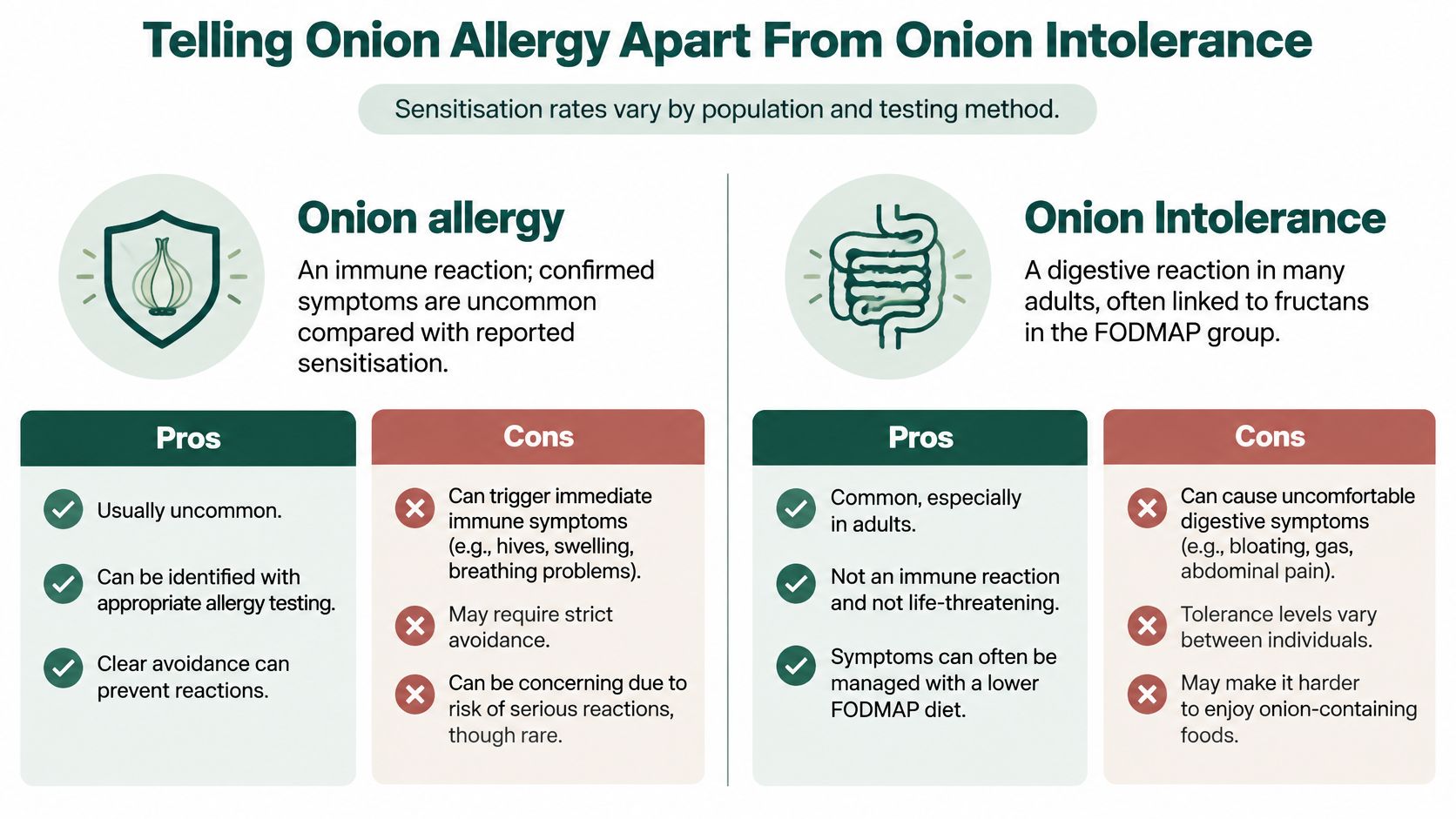
Side by side, the two mechanisms follow different rules. An onion intolerance is delayed, dose-dependent, and limited to the gastrointestinal tract without involving immune antibodies. An onion allergy involves immune recognition of onion proteins and can strike within minutes, affecting the mouth, skin, nose, or airways.
How Preparation and Pollen History Change Symptoms
Rare severe allergic events, including anaphylaxis after eating cooked onion, appear in published medical case reports. While single case reports can't measure how common an allergy is across the public, they confirm that genuine onion allergy can occasionally be life-threatening and must be respected.
Two overlooked factors often muddy the waters when adults try to self-diagnose:
- Coexisting pollen sensitization: People with seasonal pollen allergies sometimes notice mild itching in the mouth or lips immediately after biting into raw onion due to cross-reacting plant proteins, making your broader allergy history essential context for a doctor.
- Raw versus cooked preparation: Heat alters certain plant proteins while leaving others intact, so someone might react to raw diced onion in salsa yet tolerate caramelized onion, or react to cooked dishes unexpectedly. Recording the exact preparation alongside every symptom gives clinicians vital clues.
Diagnostic limits also cause frequent frustration. Standard IgE allergy testing looks for immune antibodies and cannot detect fructan-driven gut intolerance, which means a negative allergy test doesn't invalidate real digestive pain. If you're still untangling these categories, reviewing the core differences in sensitivity or intolerance versus allergy clarifies why your overall symptom pattern, not one isolated test result, determines the right medical path.
Why Onion Causes Gut Symptoms Without an Allergy
Understanding why an ordinary vegetable can leave your stomach aching starts with basic gut physics rather than immune defense. The illustration below contrasts how fermentable onion carbohydrates behave in the digestive tract versus how an immune allergy unfolds.
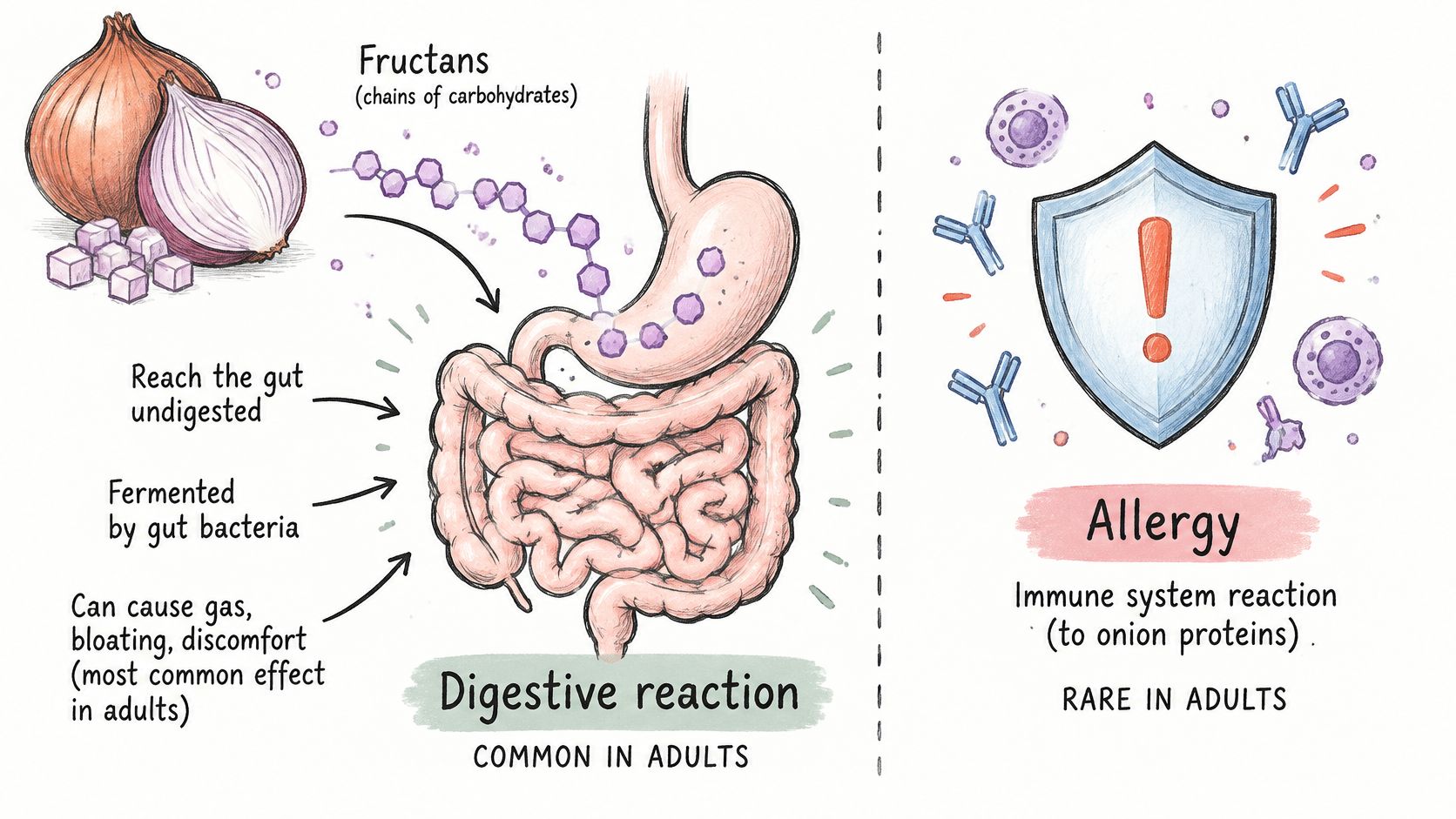
Onions are packed with fructans, chain-like carbohydrates belonging to the FODMAP group (fermentable oligosaccharides, disaccharides, monosaccharides, and polyols). Human small intestines lack the enzymes needed to break fructan chains apart efficiently. Because they remain intact, fructans draw extra water into the intestinal tract through osmosis and travel all the way down into the colon.
Picture a sealed plastic bag holding wet bread dough on a warm kitchen counter. Once yeast starts feeding on the sugars inside, gas builds steadily and the bag swells tightly until the plastic stretches. In your colon, resident gut bacteria ferment undigested fructans in much the same way, producing hydrogen, methane, short-chain fatty acids, and increased fluid volume.
Everyone produces some gas when digesting high-fructan vegetables. People with irritable bowel syndrome (IBS) or heightened gut nerve sensitivity feel that intestinal stretching far more intensely, translating normal fermentation into painful cramping, visible distension, excess flatulence, diarrhea, or shifting bowel habits.
Why Portion Size and Total Meal Load Matter
Unlike a true IgE allergy, where even a tiny trace can set off a rapid chain reaction, fructan reactions follow a clear dose-response relationship. In a randomized challenge study discussed alongside the American College of Gastroenterology clinical guideline for IBS, people with IBS who had already improved on a low-FODMAP diet experienced symptom relapse in 77% of participants after fructan exposure compared with 14% after glucose, and larger doses produced more severe symptoms.
That dose effect explains why your tolerance can seem unpredictable from one night to the next. Your gut doesn't measure onion in isolation; it responds to the cumulative fructan load across your entire meal. Two tablespoons of sautéed onion on plain grilled chicken and rice might sit well, while the exact same amount of onion served inside a wheat-pasta dish alongside garlic bread and chickpeas pushes your colon past its comfort ceiling.
For a quick visual walkthrough of how onions trigger digestive discomfort and what separates gut intolerance from allergy, watch the short explanation below.
Clinical guidance: The American College of Gastroenterology recommends a limited, professionally supervised low-FODMAP trial to improve global IBS symptoms, followed by structured single-food reintroduction rather than staying on an indefinite broad restriction.
Keep the biological boundary firm as you evaluate your symptoms. Poor fructan absorption explains bloating, cramps, wind, and bowel changes, yet it does not explain immediate hives, wheezing, throat swelling, or anaphylaxis. Any symptom outside the digestive tract deserves prompt medical evaluation.
Onion Forms and Portions That Change Your Exposure
Not every onion dish hits your digestive tract with the same force. Variety, cooking method, and serving weight all shift how much fructan reaches your colon at one sitting.
According to the A Little Bit Yummy low-FODMAP fructan guide, a published food-composition summary lists approximately 1.8 g of fructans per 100 g for white and Spanish onion, with an average 16 g serving delivering about 0.28 to 0.30 g of fructans. That baseline figure helps anchor why a light garnish behaves differently from a thick bowl of caramelized onion soup.
Other allium ingredients concentrate fructans even further. Garlic, shallots, and dense onion bulbs generally deliver substantially more fructans per practical serving than a small portion of standard sliced onion. Meanwhile, cooking softens crunchy fibers and tones down raw sharpness, yet heat doesn't reliably remove fructans. Because fructans are water-soluble, they stay inside sautéed dishes, stews, and sauces unless large amounts leach into boiling water that you drain and discard.
Comparing Everyday Onion Ingredients Side by Side
Use this comparison to see how common kitchen forms stack up when you're planning an elimination phase or testing portions.
| Form or portion | Fructan content | What it means for you |
|---|---|---|
| White or Spanish onion, raw, 100 g | About 1.8 g | Reference point for comparison |
| Average serving, 16 g of white or Spanish onion | About 0.28 to 0.30 g | Small amounts add up across a meal |
| Garlic, shallots or onion bulbs | Substantially higher per practical serving | Often creates a larger exposure than sliced onion |
| Cooked onion | Not reliably reduced | Cooking softens texture, yet fructans remain |
| Green tops of scallions or chives | Low when the white bulb is excluded | Useful flavor substitute during elimination |
| Onion powder, dehydrated onion, stock, sauces, spice blends | Concentrated and product-specific | Read labels closely; hidden onion is common |
Hidden sources trip up careful cooks more often than fresh slices do. Picture a weeknight roast dinner made with store-bought chicken stock, a packaged barbecue spice rub containing onion powder, and a drizzle of jarred pan gravy. None of those items looks like an onion on your plate, yet together they can easily exceed a full fresh serving.
During a short elimination window, you don't have to eat bland food. Finely sliced green tops of scallions (with the white bulb trimmed off) and fresh chives bring clean savory aroma without the heavy fructan load.
Because individual tolerance thresholds differ widely and fewer than half of patients react during any particular FODMAP challenge, a blanket lifelong onion ban isn't supported by evidence. Whenever you test your response, log the exact variety, cooking method, and weight in grams so you know what your gut handled.
How to Run an Elimination and Reintroduction Trial
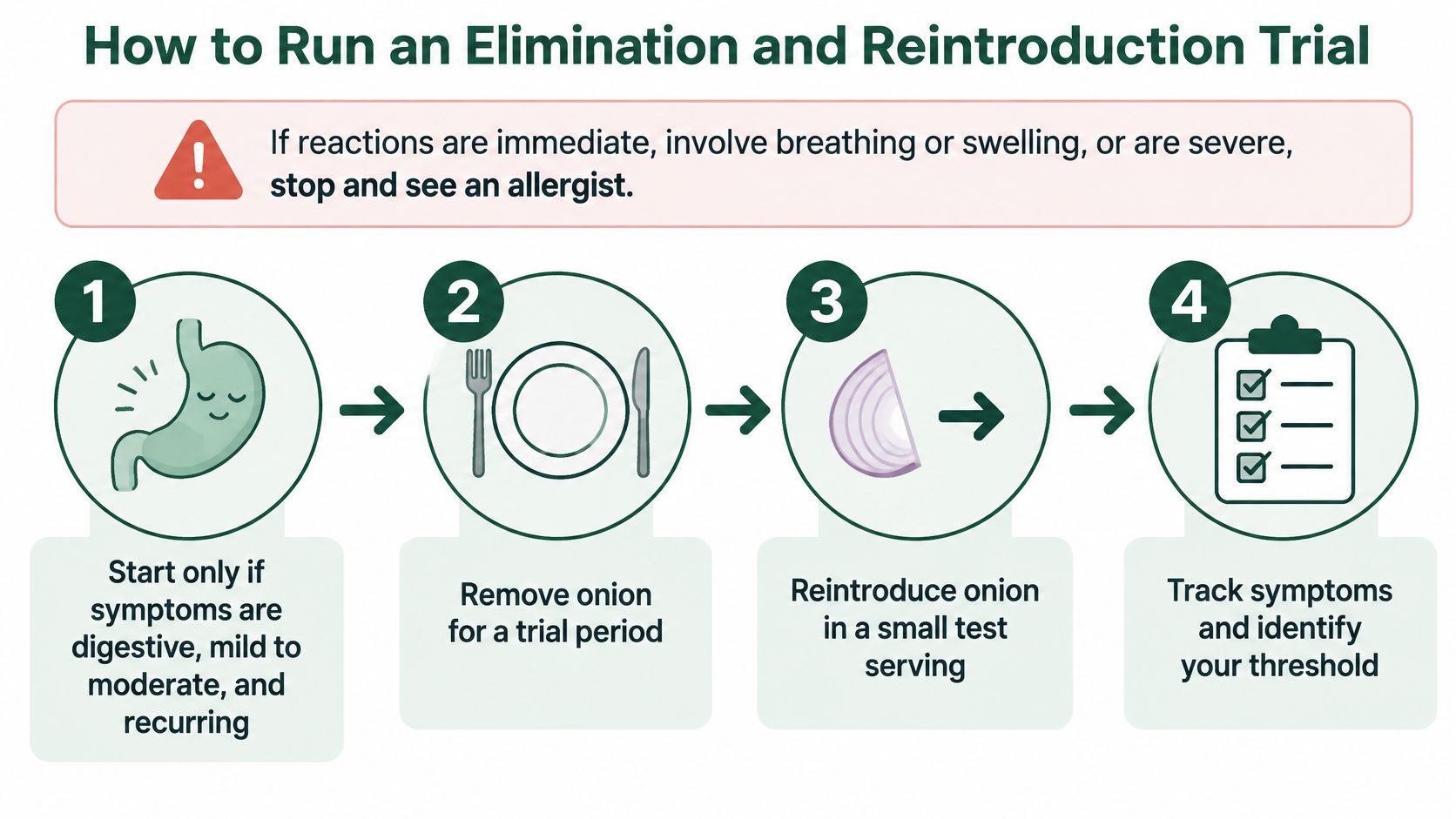
Before changing a single recipe, apply a firm safety gate. Start an at-home dietary trial only if your symptoms are digestive, mild to moderate, and recurring. If you've ever experienced immediate reactions, hives, lip or tongue swelling, wheezing, or severe distress after eating onion, stop right here and consult an allergist before testing any food.
Structured reintroduction matters because cutting out onions doesn't prove onions are the main culprit. A 2025 randomized reintroduction study indexed on PubMed in people with IBS who improved during FODMAP elimination found that fructans specifically worsened abdominal pain, reinforcing why testing individual FODMAP groups beats permanently avoiding every high-FODMAP vegetable.
The infographic below outlines the four core stages of a structured elimination and reintroduction trial from safety screening through finding your personal threshold.
Six Steps for a Structured Onion Trial
Work through these steps in order, ideally alongside a clinician or registered dietitian who can keep your meals nutritionally complete:
- Record a short baseline first. Track your normal meals and gut symptoms for several days before removing onions. Without a baseline, it's impossible to tell whether a quiet stomach comes from cutting onions or having a calmer week.
- Clear out visible and hidden onion for your set trial window. Follow a defined elimination diet agreed with your clinician, removing onion bulbs along with onion powder, dehydrated flakes, stock cubes, jarred sauces, and seasoning blends. Keep meals enjoyable by cooking with scallion green tops, chives, ginger, cumin, or fresh herbs like thyme and basil.
- Test one weighed portion on a dedicated challenge day. Once baseline digestive symptoms settle, eat a measured, weighed serving of onion (for example, starting with a small portion like 15 to 20 g of cooked white onion) while keeping the rest of that day's meals low in other fructans. Testing one food at a time ensures you know exactly what triggered any shift.
- Log symptoms for 24 to 48 hours. Colonic fermentation rarely peaks right after dinner. Watching both same-day comfort and next-day stool changes catches delayed reactions that quick mental notes miss.
- Let symptoms clear completely before the next test. Wait until your gut feels normal again before trying a larger portion or moving to a different FODMAP group such as garlic or wheat. Stacking tests back-to-back blurs the cause of a flare.
- Find your largest comfortable portion. If a small serving sits well, step up gradually on later challenge days until you spot your personal ceiling. Stop immediately if severe pain or unexpected non-digestive symptoms appear.
If months of trial and error have left you unsure which foods to prioritize before tightening your menu, our Complete Food Intolerance Test analyzes a home-collected hair sample for potential reactivity across 990 everyday food and non-food items, giving you an easy-to-understand report and practical guidance to help structure your next diet and lifestyle steps.
What to Log in Your Daily Symptom Diary
A simple notebook or phone note works fine as long as you capture six specific details for every meal and symptom episode.
| Log item | What to record | Why it matters |
|---|---|---|
| Meal time and context | Time, meal size and other dishes eaten | Shows total fructan load and timing |
| Onion exposure | Variety, preparation and grams | Lets you compare portions across challenge days |
| Hidden onion | Stocks, sauces, spice blends and labels checked | Prevents false negatives during elimination |
| Symptom type | Bloating, pain, nausea, stool change or skin or breathing symptoms | Separates digestive from immune patterns |
| Severity and onset | Severity score and hours from eating to first symptom | Reveals dose-response and delayed effects |
| Next-day effects | Stool pattern, energy and any new symptoms | Catches delayed reactions that a same-day log misses |
Keep challenge days boring everywhere else on your plate. Testing sautéed onion on the same night as a giant bowl of wheat pasta and hummus makes it impossible to tell which fructan source caused your symptoms.
When to See a Clinician and Next Steps
Certain reactions demand urgent medical action rather than dietary tweaking. Seek emergency medical care immediately if eating onion is followed by any of these red flags:
- Facial or airway swelling: Noticeable puffiness or tightness around your lips, tongue, face, or throat.
- Spreading hives: Raised, itchy welts appearing rapidly across your skin.
- Breathing difficulty: Wheezing, shortness of breath, chest tightness, or persistent coughing.
- Repeated vomiting: Sudden, forceful vomiting shortly after a small exposure.
- Dizziness or fainting: Lightheadedness, sudden weakness, or feeling like you might pass out.
Never attempt an at-home self-challenge after an immediate allergic reaction. Even if a first episode seemed manageable, a subsequent exposure can escalate unpredictably.
Diagnosing true onion allergy also requires careful clinical interpretation because the published scientific evidence isn't straightforward. In Health Canada's systematic review of garlic and onion allergenicity, reviewers concluded that the available evidence base was limited and insufficient to establish a credible cause-and-effect relationship, largely because published diagnostic findings and oral-challenge results were inconsistent. At the same time, medical case literature documents possible IgE-mediated reactions, including oral itching and hives after raw onion. When your symptom history and skin or blood test results disagree, an allergist-supervised oral food challenge is the safe gold standard to get a definitive answer.
Two naming realities also help you communicate clearly at appointments. First, "onion intolerance" isn't a standardized medical diagnosis, so describe your exact symptoms, timing, and portion sizes instead of leading with a broad label. Second, a negative allergy workup doesn't rule out fructan-triggered IBS symptoms; it points your care plan back toward digestive management.
Matching Your Symptoms to the Right Specialist
Use one clear decision rule to choose your next appointment: immediate, breathing-related, swelling, or severe reactions go straight to an allergist before you change your diet, whereas mild to moderate, recurring digestive symptoms belong in a short, supervised dietary trial supported by your medical and nutrition team.
- Primary care doctor or gastroenterologist: Book here for ongoing bloating, abdominal pain, nausea, or altered bowel habits so conditions like IBS, celiac disease, or other digestive disorders are properly assessed.
- Allergist: Essential for rapid skin, oral, throat, or breathing reactions, and for supervising oral food challenges when allergy tests and meal history don't match.
- Registered dietitian or qualified nutrition professional: Best for turning symptom diaries into a balanced meal plan that protects fiber intake and dietary variety.
A sound plan always includes a defined elimination period, single-food reintroduction, a written symptom log, and a clear stop point if your nutrition or enjoyment of food starts slipping. In our structured guidance, an elimination diet normally lasts around 4 weeks, after which items are reintroduced one by one while symptoms and wellbeing are monitored. To support those decisions, our food intolerance and sensitivity tests include 1-2-1 support from a qualified Nutritional Therapist, and every IgG and IgE test includes a 1:1 virtual consultation with a certified Nutritionist and access to the medical advisory team.
The goal of any onion trial is freedom, not permanent restriction. You're aiming to find the largest portion and preparation your body handles comfortably while keeping your plate varied and nourishing.
Three Practical Moves for This Week
Start small so you gather clean, usable data right away:
- Open a symptom diary tonight. Log your meals, onion forms, and next-day gut comfort for the next week before dropping any ingredients.
- Audit your pantry labels. Check stock cubes, soup bases, pasta sauces, and spice blends for onion powder or dehydrated onion so you know where hidden fructans sneak in.
- Book a clinical review for recurring or red-flag symptoms. Bring your written diary to your doctor or allergist so your next step rests on clear patterns rather than guesswork.
If recurring digestive discomfort has left you guessing whether a food intolerance to onion or another everyday ingredient is behind your symptoms, we offer at-home hair and blood testing options paired with one-to-one guidance from qualified nutrition professionals. From structured elimination and reintroduction support to personalized meal planning and virtual consultations, our services help you turn confusing meal reactions into a clear, balanced eating plan. Explore your testing options and guided support at Check My Body Health.
Composed with Outrank tool